- Products
- Learn
- Local User Groups
- Partners
- More
MVP 2026: Submissions
Are Now Open!
What's New in R82.10?
10 December @ 5pm CET / 11am ET
Announcing Quantum R82.10!
Learn MoreOverlap in Security Validation
Help us to understand your needs better
CheckMates Go:
Maestro Madness
Dear all,
I have a question about ethtool statistics.
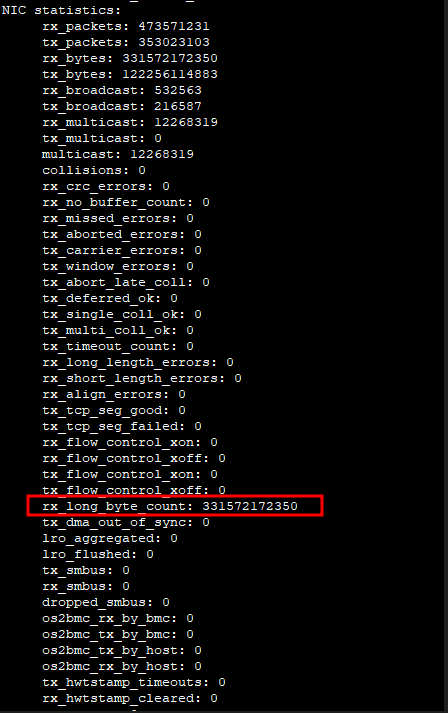
Below are the ethtool stats from Security Gateway.
The value of rx_long_byte_count continues to increase.
I want to know what these counts mean and what problems may arise.
Thanks
No, rx_long_length_errors indicate the receipt of an overly large frame in excess of the MTU (this used to be called a "jabber" long ago, along with "runts" for frames that were too short) but it is 0 in this case. I'm not completely sure what rx_long_byte_count is trying to indicate, but it always seems to match rx_bytes precisely on every system I've seen. Unfortunately these counter names are not standardized between NIC vendors and can mean just about anything.
If I had to take a wild guess, perhaps rx_bytes indicates the number of payload/data (i.e. non-header) bytes received at the hardware NIC level off the wire, while rx_long_byte_count reports the number of payload/data bytes that actually made it up into the receive socket buffer (referenced by a ring buffer descriptor), after the DMA transfer from the NIC hardware buffer into Gaia's memory. Perhaps "long" in this context indicates a frame that has a nonzero number of payload/data bytes.
Obviously these two counter values should always match, and if they don't that indicates some kind of bug in the NIC driver or SoftIRQ routine that a coder would need to address. Just a guess though...
Believe it's a somewhat redundant counter covered by rx_bytes (third row from the top).
Whereas if it were rx_long_length_errors then you'd be looking at a potential MTU issue (refer: sk115357).
Seems like connected interface is getting jumbo-frame packets (A packet size more than 1500-1522 bytes) and if MTU is not set accordingly then these packets will keep dropping until the MTU is not properly configured to accept the jumbo-frames.
I don't think it's going to create an issue but it's wasting the resources.
Regards,
Hasnain Ansari
This is incorrect in my opinion, you'll note the count of rx_bytes & rx_long_byte_count is the same value.
As per my understanding rx_bytes is the total (good data/frames) received at the interface and rx_long_byte_count means count of jumbo frame that hit at this interface.
Why these 2 things are showing same value ? Any difference ?
Correct me if i missed something.
I tend to agree with your assessment, as I had seen this before and thats exactly what the issue was.
No, rx_long_length_errors indicate the receipt of an overly large frame in excess of the MTU (this used to be called a "jabber" long ago, along with "runts" for frames that were too short) but it is 0 in this case. I'm not completely sure what rx_long_byte_count is trying to indicate, but it always seems to match rx_bytes precisely on every system I've seen. Unfortunately these counter names are not standardized between NIC vendors and can mean just about anything.
If I had to take a wild guess, perhaps rx_bytes indicates the number of payload/data (i.e. non-header) bytes received at the hardware NIC level off the wire, while rx_long_byte_count reports the number of payload/data bytes that actually made it up into the receive socket buffer (referenced by a ring buffer descriptor), after the DMA transfer from the NIC hardware buffer into Gaia's memory. Perhaps "long" in this context indicates a frame that has a nonzero number of payload/data bytes.
Obviously these two counter values should always match, and if they don't that indicates some kind of bug in the NIC driver or SoftIRQ routine that a coder would need to address. Just a guess though...
Leaderboard
Epsum factorial non deposit quid pro quo hic escorol.
| User | Count |
|---|---|
| 22 | |
| 20 | |
| 16 | |
| 8 | |
| 7 | |
| 3 | |
| 3 | |
| 3 | |
| 3 | |
| 3 |
Fri 12 Dec 2025 @ 10:00 AM (CET)
Check Mates Live Netherlands: #41 AI & Multi Context ProtocolTue 16 Dec 2025 @ 05:00 PM (CET)
Under the Hood: CloudGuard Network Security for Oracle Cloud - Config and Autoscaling!Fri 12 Dec 2025 @ 10:00 AM (CET)
Check Mates Live Netherlands: #41 AI & Multi Context ProtocolTue 16 Dec 2025 @ 05:00 PM (CET)
Under the Hood: CloudGuard Network Security for Oracle Cloud - Config and Autoscaling!About CheckMates
Learn Check Point
Advanced Learning
YOU DESERVE THE BEST SECURITY