- Products
- Learn
- Local User Groups
- Partners
- More

MVP 2026: Submissions
Are Now Open!
What's New in R82.10?
10 December @ 5pm CET / 11am ET
Announcing Quantum R82.10!
Learn MoreOverlap in Security Validation
Help us to understand your needs better
CheckMates Go:
Maestro Madness
We're working with a customer who wishes to make a whitelist entry for a range of AWS S3 bucket addresses in their firewall. The names would be in the form:
abc-*-xyz.s3-us-east-2.amazonaws.com
OR
abc-*-xyz.s3.us-west-1.amazonaws.com
Where the "*" would be a randomly generated string that maps to an ephemeral name for a particular S3 bucket.
They are claiming this is not possible because the host in the URI has more than 3 parts. So they say that if it were "abc-*-xyz.amazonaws.com" it could work. But the other pieces in that host make it an invalid authority to use in a whitelist entry.
Is that true? Might it be a limitation of some very old version? I would welcome any pointers to appropriate documentation about this as well as answers.
Thanks!
That doesn't sound right.
What steps are they following to try and do this on which version?
These were, of course, my first questions as well. I am awaiting replies on both. The other detail that I do know is that this is related to deep packet inspection with SSL. The reason for the whitelisting is to have the data streams inbound from S3 on those address patterns exempt from the inspection.
In general, do you believe that a host in a URI can only have 3 parts? Or can it be arbitrarily long so long as it is a valid host name?
I've never heard of such a limitation myself (related to number of hosts/domain in a URI).
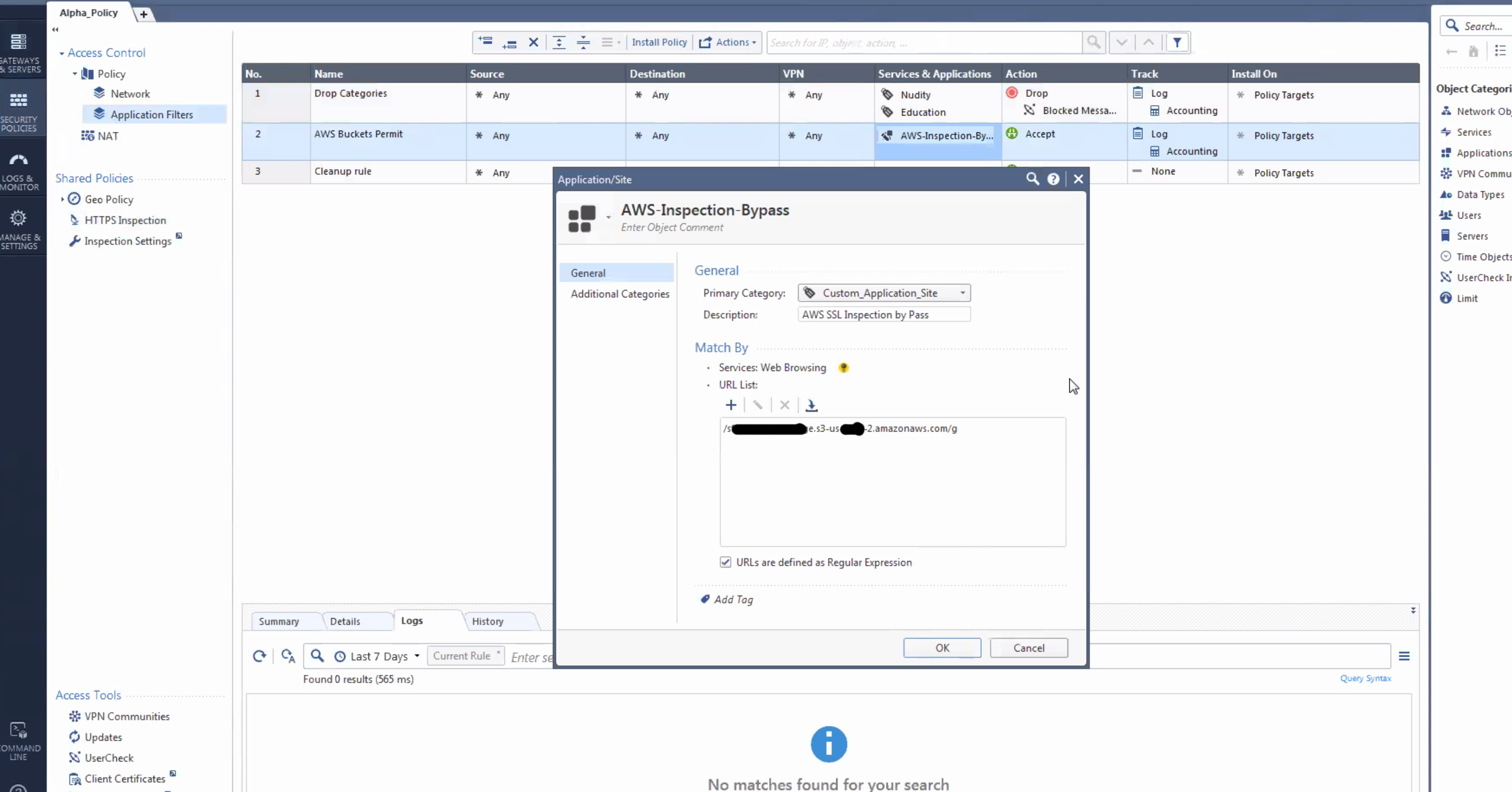
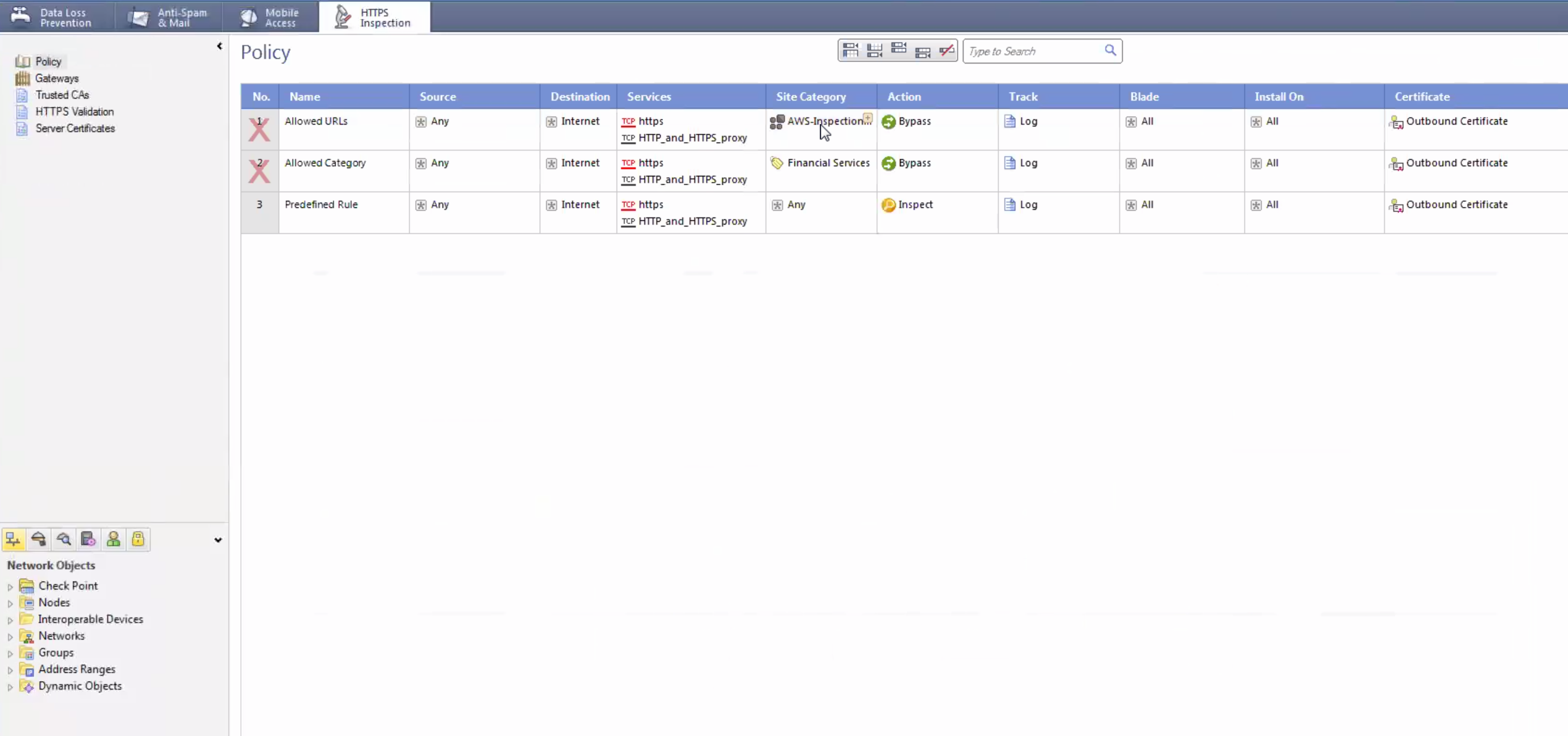
Spoke to an engineer today who pointed out that if you create the URL as a regex instead of a plain URL, you can essentially use any form you need to. So that may be a solution for us in this case, and certainly may help others facing similar challenges. This would then be connected to the https inspection policy as an exception to avoid the deep packet inspection.

Regex is definitely the way to go with this.
As I recall, you can't use a custom application in the HTTPS Inspection rulebase, but you should be able to use the "category".
Is that working for you?
I'm doing all of this through proxies (people), but the way this engineer configured it was to add an entry to the policy for HTTPS inspection to bypass anything that matched those regexs for the URLs. That did seem to do the trick according to what we could tell. This was done on 80.10, but still not clear the exact version the client has.

Looks like this was all the result of confusion. With some help from Brian Butts, what we discovered is that if you request something like bucketname.s3.us-west-2.amazonaws.com from AWS, they will respond from s3.us-west-2.amazonaws.com, and their certificate shows *.s3-us-west-2.amazonaws.com. These translations that cut off the bucket name likely account for the thought that the rules woudl not work with longer address, since these longer addresses were not involved with the responses and therefore a bypass on them would never work. SO it's a different issue all together.
I've opened a new thread to discuss this: https://community.checkpoint.com/message/28606-base-a-bypass-rule-on-the-request-address-not-the-res...
Leaderboard
Epsum factorial non deposit quid pro quo hic escorol.
| User | Count |
|---|---|
| 16 | |
| 13 | |
| 8 | |
| 7 | |
| 6 | |
| 4 | |
| 3 | |
| 3 | |
| 2 | |
| 2 |
Fri 12 Dec 2025 @ 10:00 AM (CET)
Check Mates Live Netherlands: #41 AI & Multi Context ProtocolTue 16 Dec 2025 @ 05:00 PM (CET)
Under the Hood: CloudGuard Network Security for Oracle Cloud - Config and Autoscaling!Fri 12 Dec 2025 @ 10:00 AM (CET)
Check Mates Live Netherlands: #41 AI & Multi Context ProtocolTue 16 Dec 2025 @ 05:00 PM (CET)
Under the Hood: CloudGuard Network Security for Oracle Cloud - Config and Autoscaling!About CheckMates
Learn Check Point
Advanced Learning
YOU DESERVE THE BEST SECURITY