- Products
- Learn
- Local User Groups
- Partners
- More
MVP 2026: Submissions
Are Now Open!
What's New in R82.10?
10 December @ 5pm CET / 11am ET
Announcing Quantum R82.10!
Learn MoreOverlap in Security Validation
Help us to understand your needs better
CheckMates Go:
Maestro Madness
Hi
Our customer is using 6500 appliance and we're observing an uneven load of MultiQueue cores. They're using R80.40, JHF T78
Affinity:
[Expert@FW01:0]# fw ctl affinity -l -r
CPU 0:
CPU 1: fw_5
in.asessiond lpd topod fwucd pepd in.acapd mpdaemon usrchkd pdpd vpnd wsdnsd rtmd in.geod rad fwd cprid cpd
CPU 2: fw_3
in.asessiond lpd topod fwucd pepd in.acapd mpdaemon usrchkd pdpd vpnd wsdnsd rtmd in.geod rad fwd cprid cpd
CPU 3: fw_1
in.asessiond lpd topod fwucd pepd in.acapd mpdaemon usrchkd pdpd vpnd wsdnsd rtmd in.geod rad fwd cprid cpd
CPU 4:
CPU 5: fw_4
in.asessiond lpd topod fwucd pepd in.acapd mpdaemon usrchkd pdpd vpnd wsdnsd rtmd in.geod rad fwd cprid cpd
CPU 6: fw_2
in.asessiond lpd topod fwucd pepd in.acapd mpdaemon usrchkd pdpd vpnd wsdnsd rtmd in.geod rad fwd cprid cpd
CPU 7: fw_0
in.asessiond lpd topod fwucd pepd in.acapd mpdaemon usrchkd pdpd vpnd wsdnsd rtmd in.geod rad fwd cprid cpd
All:
Interface eth1: has multi queue enabled
Interface eth2: has multi queue enabled
Interface eth3: has multi queue enabled
Interface eth4: has multi queue enabled
Interface Sync: has multi queue enabled
Interface Mgmt: has multi queue enabled
Multiqueue:
[Expert@FW01:0]# mq_mng -o -vv
Total 8 cores. Multiqueue 2 cores: 4,0
i/f type state mode cores
------------------------------------------------------------------------------------------------
Mgmt igb Up Dynamic (2/2) 0(63),4(64)
eth1 igb Up Dynamic (2/2) 0(45),4(65)
eth2 igb Up Dynamic (2/2) 0(49),4(66)
eth3 igb Up Dynamic (2/2) 0(53),4(67)
eth4 igb Up Dynamic (2/2) 0(57),4(68)
------------------------------------------------------------------------------------------------
Mgmt <igb> max 2 cur 2
0e:00.0 Ethernet controller: Intel Corporation I211 Gigabit Network Connection (rev 03)
------------------------------------------------------------------------------------------------
eth1 <igb> max 2 cur 2
03:00.0 Ethernet controller: Intel Corporation I211 Gigabit Network Connection (rev 03)
------------------------------------------------------------------------------------------------
eth2 <igb> max 2 cur 2
05:00.0 Ethernet controller: Intel Corporation I211 Gigabit Network Connection (rev 03)
------------------------------------------------------------------------------------------------
eth3 <igb> max 2 cur 2
07:00.0 Ethernet controller: Intel Corporation I211 Gigabit Network Connection (rev 03)
------------------------------------------------------------------------------------------------
eth4 <igb> max 2 cur 2
09:00.0 Ethernet controller: Intel Corporation I211 Gigabit Network Connection (rev 03)
core interfaces queue irq rx packets tx packets
------------------------------------------------------------------------------------------------
0 eth4 eth4-TxRx-0 57 25769 23193
eth3 eth3-TxRx-0 53 1545150 904071
eth2 eth2-TxRx-0 49 433865741 466353128
eth1 eth1-TxRx-0 45 911210633 1500606188
Mgmt Mgmt-TxRx-0 63 9716772 2463400
4 eth4 eth4-TxRx-1 68 622046 662303
eth3 eth3-TxRx-1 67 952119 1662619
eth2 eth2-TxRx-1 66 390618898 446742240
eth1 eth1-TxRx-1 65 942002645 425528973
Mgmt Mgmt-TxRx-1 64 1238135 17131300
This is the data for CPU usage for a day. It shows that CPU4 is utilised a lot less than CPU0.
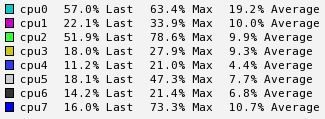
@Timothy_Hall probably has the best idea why this could be happening 🙂
To my knowledge Multi-Queue uses a hash of various packet header fields to select which eligible SND core should handle all packets for the life of that connection. Once that selection is made, all packets of that connection will always be handled by that specific SND core. If your connections are not sufficiently diverse as far as IP addresses and port numbers, similar connections may tend to congregate on a single SND core driving up its load; this will be much more noticeable with only 2 SND cores. Because there is no way to know whether the new connection will be an elephant flow it is possible for lots of non-diverse ones to end up on the same core. I don't think there is much you can do about this unless you want to move from the default 2/6 split to 4/4, and I'm not sure the remaining 4 Firewall Worker cores will be able to handle the load.
There are some other known situations that can cause a significant imbalance between the SND cores like this one that was already fixed in the release you are running:
sk165853: High CPU usage on one CPU core when the number of Remote Access users is high
Elephant flow hitting CPU 0 maybe?
We are experiencing some elephant flows through the VPN's but they're not consistent. The CPU consumption difference however, is.
To my knowledge Multi-Queue uses a hash of various packet header fields to select which eligible SND core should handle all packets for the life of that connection. Once that selection is made, all packets of that connection will always be handled by that specific SND core. If your connections are not sufficiently diverse as far as IP addresses and port numbers, similar connections may tend to congregate on a single SND core driving up its load; this will be much more noticeable with only 2 SND cores. Because there is no way to know whether the new connection will be an elephant flow it is possible for lots of non-diverse ones to end up on the same core. I don't think there is much you can do about this unless you want to move from the default 2/6 split to 4/4, and I'm not sure the remaining 4 Firewall Worker cores will be able to handle the load.
There are some other known situations that can cause a significant imbalance between the SND cores like this one that was already fixed in the release you are running:
sk165853: High CPU usage on one CPU core when the number of Remote Access users is high
Thanks Timothy
That's a promising SK. There is indeed a lot of VPN traffic right now due to Covid situation. Absolutely worth trying changing the kernel parameter according to the SK. Will schedule a maintenance window with the customer to try. Will update with the findings.
The procedure form the SK worked. The multiqueue cores are now almost identically utilized.
Best regards
Borut
Leaderboard
Epsum factorial non deposit quid pro quo hic escorol.
| User | Count |
|---|---|
| 26 | |
| 20 | |
| 16 | |
| 5 | |
| 4 | |
| 4 | |
| 4 | |
| 3 | |
| 3 | |
| 3 |
Fri 12 Dec 2025 @ 10:00 AM (CET)
Check Mates Live Netherlands: #41 AI & Multi Context ProtocolTue 16 Dec 2025 @ 05:00 PM (CET)
Under the Hood: CloudGuard Network Security for Oracle Cloud - Config and Autoscaling!Fri 12 Dec 2025 @ 10:00 AM (CET)
Check Mates Live Netherlands: #41 AI & Multi Context ProtocolTue 16 Dec 2025 @ 05:00 PM (CET)
Under the Hood: CloudGuard Network Security for Oracle Cloud - Config and Autoscaling!Thu 18 Dec 2025 @ 10:00 AM (CET)
Cloud Architect Series - Building a Hybrid Mesh Security Strategy across cloudsAbout CheckMates
Learn Check Point
Advanced Learning
YOU DESERVE THE BEST SECURITY