- Products
- Learn
- Local User Groups
- Partners
- More
What’s New in Agentic Network Orchestration
21 October @ 5pm CET / 11am EDT
AI Security Masters
LGTM: Bypassing an LLM Build Gate
When Prompt Injection Fails
Scaling Check Point Automation with Arodonata
CheckMates Go:
Fun Ding
| Chapter |
|---|
More interesting articles:
- R80.x Architecture and Performance Tuning - Link Collection
- Article list (Heiko Ankenbrand)
| Flowchart news in R80.20 and above |
|---|
SecureXL has been significantly revised in R80.20. This has also led to some changes in "fw monitor". There are new fw monitor chain (SecureXL) objects that do not run in the virtual machine.
Now SecureXL works in part in user space. The SecureXL driver takes a certain amount of kernel memory per core and that was adding up to more kernel memory than Intel/Linux was allowing. The packet flow in R80.20+ is a little bit different from the flow lower than R80.20. Now it is possible to use async SecureXL and other new functions. This figure shows the new features with the reinjection of SecureXL packages. SecureXL supportes now also Async SecureXL with Falcon cards. That's new in acceleration high level architecture (SecureXL on Acceleration Card): Streaming over SecureXL, Lite Parsers, Scalable SecureXL, Acceleration stickiness...
More informations here: R80.x Security Gateway Architecture (Logical Packet Flow)
Whats new in R80.20+:
Now there are several SecureXL instances possible. As a result, packets are reinjected with the new SecureXL ID into the correct SecureXL instance again after they have been allowed by access template or rule set. After the packet has been reinjected, the SecureXL ID is added to the SecureXL connetion table and the packet is forwarded to the correct SecureXL instance. Therefore the flow is slightly different to older version before R80.20. This new mechanism also offers the possibility to transfer packets into a new SecureXL instance on Falcon cards.
PXL vs. PSLXL - Technology name for combination of SecureXL and PSL. PXL was renamed to PSLXL in R80.20. This is from my point of view the politically correct better term.
For the new acceleration Falcon card architecture with R80.20+ and SecureXL offloading read this article:
R80.x Security Gateway Architecture (Acceleration Card Offloading):
THX @PhoneBoy,
I'll change tomorrow in the next version.
Hi @PhoneBoy, Hi @Daniel_Hainich
THX is changed.
Typos aren't a problem. The content is important.
And I think that is brilliant information from @HeikoAnkenbrand.
I also added the paths (Slow Path, Medium Path and Fast Path) marked in color.
Now there are several SecureXL instances possible. As a result, packets are reinjected with the new SecureXL ID into the correct SecureXL instance again after they have been allowed by access template or rule set. After the packet has been reinjected, the SecureXL ID is added to the SecureXL connettion table and the packet is forwarded to the correct SecureXL instance. Therefore the flow is slightly different to older version before R80.20. This new mechanism also offers the possibility to transfer packets into a new SecureXL instance on Falcon cards.
Why packets reinjection with the neu SecureXL ID into the correct SecureXl instance is needed?
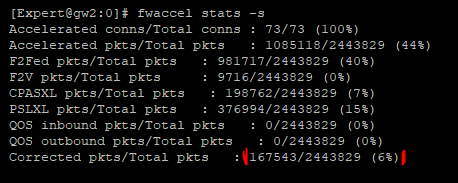
Starting in R80.20 there can be more than one instance of SecureXL present on the gateway, but the only way you can have this situation is if a Falcon card is present (which is essentially another instance of SecureXL running on the card itself). If a packet is received by the "wrong" instance of SecureXL on a gateway, it is forwarded to the correct instance and the packet is counted as a "correction" in the output of commands like fwaccel stats -s.
Yes @Timothy_Hall describes this well, from R80.20 there are correction flows. They forward the packet to the correct SecureXL instance.
Through reinjection, the packet is tagged with the correct SecureXL ID and then forwarded to the appropriate SecureXL instance. This is now also described in the new R80.30 document Performance Tuning R80.30 Administration Guide.
Here is a picture from a LAB appliance with corrected packet flow:
Great info.
Nice update.
😀
Nice informaton update!
Is this CCSE exam relevant?
Technically speaking, no. However, this helps with understanding of technology. That said, I advise you to stick with official documentation and course textbooks for certification
Leaderboard
Epsum factorial non deposit quid pro quo hic escorol.
| User | Count |
|---|---|
| 52 | |
| 20 | |
| 19 | |
| 11 | |
| 10 | |
| 8 | |
| 8 | |
| 6 | |
| 6 | |
| 5 |
Thu 08 Oct 2026 @ 11:00 AM (EDT)
Under the Hood: Check Point SASE | Zero Trust Network Access, Step by StepFri 09 Oct 2026 @ 10:00 AM (CEST)
CheckMates Live Netherlands - Sessie 49: Maak kennis met Check Point R82.20Tue 13 Oct 2026 @ 06:00 PM (IDT)
AI Security Masters: LGTM: Bypassing an LLM Build Gate When Prompt Injection FailsThu 08 Oct 2026 @ 11:00 AM (EDT)
Under the Hood: Check Point SASE | Zero Trust Network Access, Step by StepFri 09 Oct 2026 @ 10:00 AM (CEST)
CheckMates Live Netherlands - Sessie 49: Maak kennis met Check Point R82.20Thu 15 Oct 2026 @ 05:00 PM (CEST)
What If Email Security Ran Your Security Awareness Program?Tue 20 Oct 2026 @ 04:00 PM (CEST)
EMEA: Beyond the Basics: Designing Identity Awareness for Large-Scale EnvironmentsThu 29 Oct 2026 @ 11:00 AM (PDT)
Irvine, CA: Secure the Network, the App, and the Workforce: A Hybrid Mesh & SASE BriefingAbout CheckMates
Learn Check Point
Advanced Learning
YOU DESERVE THE BEST SECURITY