- Products
- Learn
- Local User Groups
- Partners
- More

MVP 2026: Submissions
Are Now Open!
What's New in R82.10?
Watch NowOverlap in Security Validation
Help us to understand your needs better
CheckMates Go:
Maestro Madness
Can anyone please tell me what DLE stands for in the world of Check Point?
I just want to get a basic understanding of the key database table, or specifically the meaning of DLE in the name dleobjectderef_data and what the DLE schema is about.
This is for educational/overview and basic understanding purposes only.
Thanks,
Don
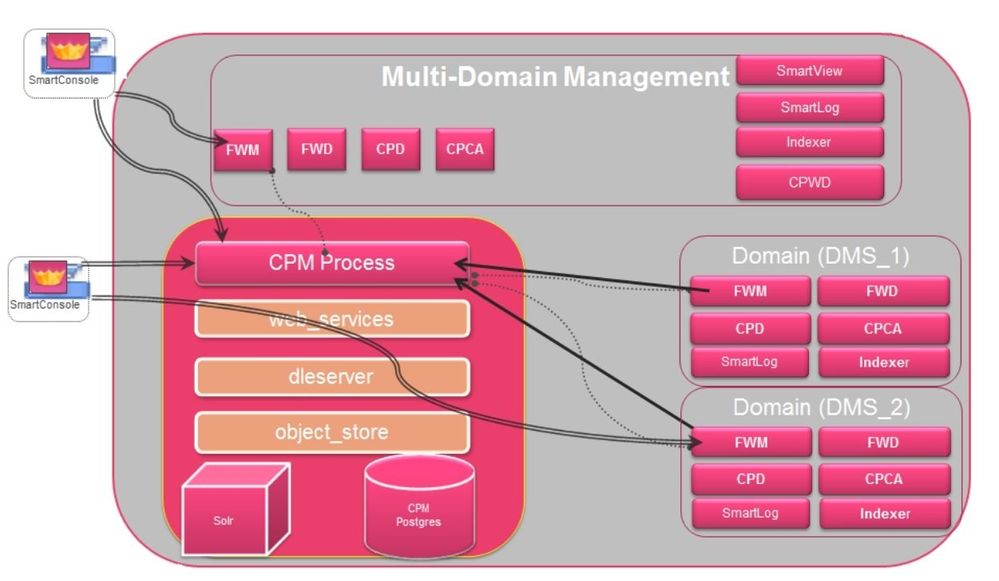
DLE server is a component within the CPM server that contains all the logic of the server to writing the info to the database and SOLR.
CPM process is responsible for writing all information to the PostgreSQL and SOLR databases.
More see here:
ATRG: Multi-Domain Security Management R80.x
Or this video:
Thanks Heiko, but I am aware of the DLE Server (dleserver process) and the theory behind that.
This SK has the same info (and more): https://supportcenter.checkpoint.com/supportcenter/portal?eventSubmit_doGoviewsolutiondetails=&solut...
What I am looking for what DLE actually stands for (and therefore means), and an explanation behind the schema part of it if possible too.
The dleobjectderef_data is a key Postgres table and contains reference information related to all objects in the database but what does DLE mean and what does DEREF mean?
To me it seem like DLE is like ELG (fwd.elg) in terms of these being very specific to Check Point in that they are names (file extensions in the case of .elg files) solely used by CHKP.
Regards,
Don
I'm assuming DEREF is short for "dereference". In the context of the SMS, I'd surmise dereferencing treats the object UIDs (or other attributes) as a pointer to the full underlying object properties. As stated on page 25 of the CCSM guide, the table dleobjectderef_data contains object attributes that are accessible by "legacy" management processes such as fwm, as that object data was originally stored in the proprietary CPMI format prior to R80 (objects_5_0.C?). The other postgres table CPNetworkObject_data is for the "new" R80+ processes like cpm, and those two tables are kept synchronized in the database. So I'd guess the dleobjectderef_data table is essentially backwards compatibility for the older process elements of the SMS implementation, and helped avoid the massive effort that would have been required to rewrite the legacy processes like fwm to utilize the new database structure for objects via CPNetworkObject_data.
Thanks Dameon
Note. That table is one of two covered in the CCSM course. 😉
If I deliver the course and get the question I like to have an answer or something official anyway. I am also curious because I am exposed to it.
It's probably a good thing to at least have the full words for the acronyms.
Leaderboard
Epsum factorial non deposit quid pro quo hic escorol.
| User | Count |
|---|---|
| 17 | |
| 15 | |
| 7 | |
| 5 | |
| 5 | |
| 5 | |
| 4 | |
| 4 | |
| 4 | |
| 4 |
Tue 16 Dec 2025 @ 05:00 PM (CET)
Under the Hood: CloudGuard Network Security for Oracle Cloud - Config and Autoscaling!Thu 18 Dec 2025 @ 10:00 AM (CET)
Cloud Architect Series - Building a Hybrid Mesh Security Strategy across cloudsTue 16 Dec 2025 @ 05:00 PM (CET)
Under the Hood: CloudGuard Network Security for Oracle Cloud - Config and Autoscaling!Thu 18 Dec 2025 @ 10:00 AM (CET)
Cloud Architect Series - Building a Hybrid Mesh Security Strategy across cloudsAbout CheckMates
Learn Check Point
Advanced Learning
YOU DESERVE THE BEST SECURITY