- Products
- Learn
- Local User Groups
- Partners
- More

Scaling Check Point Automation with Arodonata
7 October @ 5pm CET / 11am EDT
AI Security Masters
LGTM: Bypassing an LLM Build Gate
When Prompt Injection Fails
What's New in Check Point SASE
The State of Ransomware Q2 2026:
This Quarter's Trends, and Their Impact on Your Defenses
CheckMates Go:
Half is Not Enough
Hello,
This is related Network Feeds object mentioned in the What's New in R81.20 TechTalk webinar this week.
I have a few questions re the Network Feeds object.
What file type is the file the Network Feeds object?
If there is no strict formatting;
We just started using generic data center objects block malicious IPs from verified threat intelligence feeds. As you stated, the generic data center object references a JSON file with strict formatting requirements. However, there is still no built-in protection for data validation.
To mitigate input errors i.e. input data that doesn't conform to the strict formatting, we validate the JSON against a schema before copying the file to a web or the management server.
In terms of scalability, the JSON should be able to handle a lot of IPs. Can you explain the advantage of the new object in further detail here?
I would be interested to look at any additional information you're able to provide on the Network Feeds object.
@Tomer_Noy are you able to shed some more light on these objects?
Regards,
Simon
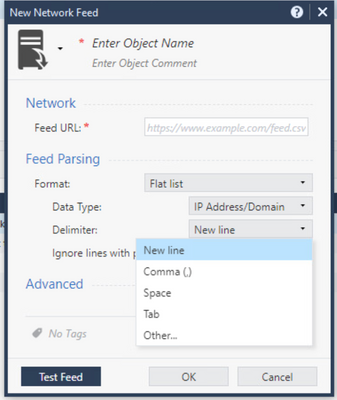
In addition to being JSON, for which you can specify a 'jq' query to pull out the precise fields you're interested in, a "flat file" type is supported.
You specify the precise formatting when you define the object:
The Data Type of the feed can be:
As for the benefit of this new method, there are a few:
Hopefully I got everything that's pertinent 🙂
Edit: See also the official documentation on this feature
https://sc1.checkpoint.com/documents/R81.20/WebAdminGuides/EN/CP_R81.20_SecurityManagement_AdminGuid...
All of @PhoneBoy's comments are accurate.
In addition, to answer your remaining questions:
An invalid entry will not break the entire feed and will simply be skipped. I just tried it to verify 😀
(take a look at the attached pictures)
Also, if the feed is completely broken or inaccessible, the gateway will continue to use cached contents from the last successful fetch.
You can of course add your custom validations to some CI/CD pipeline before updating the feed files (whether JSON or flat files).
All of @PhoneBoy's comments are accurate.
In addition, to answer your remaining questions:
An invalid entry will not break the entire feed and will simply be skipped. I just tried it to verify 😀
(take a look at the attached pictures)
Also, if the feed is completely broken or inaccessible, the gateway will continue to use cached contents from the last successful fetch.
You can of course add your custom validations to some CI/CD pipeline before updating the feed files (whether JSON or flat files).
All of @PhoneBoy's comments are accurate.
In addition, to answer your remaining questions:
An invalid entry will not break the entire feed and will simply be skipped. I just tried it to verify 😀
(take a look at the attached pictures)
Also, if the feed is completely broken or inaccessible, the gateway will continue to use cached contents from the last successful fetch.
You can of course add your custom validations to some CI/CD pipeline before updating the feed files (whether JSON or flat files).
Thanks for the information.
If flat file format is selected, do you know if any validation is done on the IP or domain values to ensure they are valid inputs? If not, and an invalid entry is added, does this break the entire network feed object?
With JSON selection, if there is no built-in validation, we can perform our own validation against a JSON schema which we currently do.
Regards,
Simon
Thanks for the information.
If flat file format is selected, do you know if any validation is done on the IP or domain values to ensure they are valid inputs? If not, and an invalid entry is added, does this break the entire network feed object?
With JSON selection, if there is no built-in validation, we can perform our own validation against a JSON schema which we currently do.
Regards,
Simon